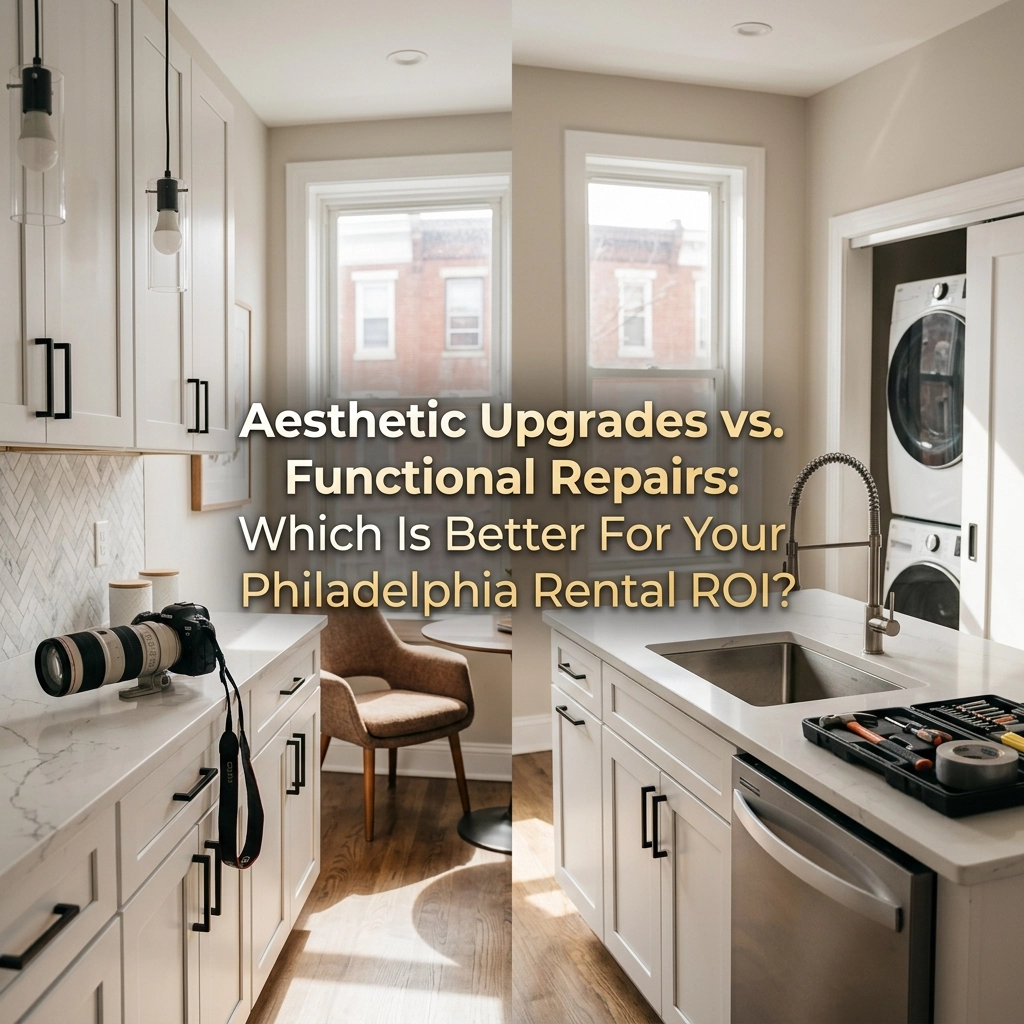
As a Philadelphia property owner, you’re constantly walking a tightrope. On one side, you want to maximize your monthly rental income by making the property look like something out of a luxury lifestyle magazine. On the other side, you’re staring at an aging boiler, a drafty set of windows, and the looming threat of the City’s Proactive Inspection Program.
The big question is: where do you put your next dollar to get the best Return on Investment (ROI)? Should you install those trendy subway tiles in the kitchen, or should you finally replace the 30-year-old electrical panel?
At C&A Property Services, we see this struggle every day during turnovers. The truth is, the answer isn’t a simple "either/or." It’s about a strategic sequence that protects your asset while driving up its market value.
The Foundation: Why Functional Repairs Are Non-Negotiable in Philly
In the Philadelphia rental market, functional repairs aren't just about maintenance; they are about legal survival. With the city moving toward more aggressive enforcement of the Philadelphia Safe Healthy Homes Act, a "pretty" house that fails a basic health inspection is a liability, not an asset.
Functional repairs cover the "bones" of the house: plumbing, electrical, HVAC, roofing, and structural integrity. If these systems fail, your ROI doesn't just dip, it vanishes. A single burst pipe can cause $15,000 in water damage, far outweighing the $500 you saved by skipping a plumbing check.
Furthermore, Philadelphia’s Proactive Rental Inspections are designed to catch functional failures before they become tenant complaints. If you prioritize a new backsplash over fixing a faulty water heater, you’re essentially inviting a code violation that could lead to your rental license being revoked.

Case File: The South Philly "Glitter" Disaster of 1994
To understand the risk of prioritizing aesthetics over function, we can look back at a classic case from our archives. In the early 90s, a landlord in South Philadelphia purchased a classic three-story rowhome. Eager to attract high-paying professionals moving into the city, he spent his entire renovation budget on high-end crown molding, imported Italian marble countertops, and designer wallpaper.
He ignored the "rumbling" in the basement, a cast-iron boiler that had been original to the house’s mid-century update.
In February 1994, during a record-breaking cold snap, the boiler gave out. The pipes froze and subsequently burst throughout the house. The "designer" wallpaper was shredded by water pressure, the marble countertops were stained by rusty sludge, and the crown molding warped and fell from the ceiling. Because he had spent his reserves on the "glitter," he didn't have the immediate cash to fix the boiler. The tenants moved out, he was hit with multiple L&I violations, and the property sat vacant for six months.
The lesson? Aesthetics attract tenants, but functional repairs keep them, and protect your investment from total loss.
The Aesthetic Edge: Where Style Actually Pays Off
Once the "bones" are solid, aesthetic upgrades are your primary tool for increasing rent. In a competitive market like Fishtown or University City, tenants have choices. They will almost always choose the unit that looks fresh and modern.
The key is focusing on High-Perceived-Value upgrades. You don't need to spend $20,000 on a kitchen to increase rent by $200 a month. Research shows that:
- Paint is King: A fresh coat of neutral, modern paint (think light greys or "greige") offers the highest dollar-for-dollar ROI of any improvement. It covers smells, hides scuffs, and makes a space feel brand new.
- Flooring: Replacing old, stained carpet with Luxury Vinyl Plank (LVP) is a game-changer. It looks like hardwood, is nearly indestructible, and makes the unit much easier to clean during turnovers.
- Hardware and Lighting: Swapping out 1980s brass doorknobs and yellowing light fixtures for matte black or brushed nickel alternatives can modernize a room for less than $100.
If you’re struggling with high turnover costs, sometimes a few simple aesthetic tweaks are all it takes to attract a higher-tier tenant who will stay for years rather than months.

Comparing the ROI: Function vs. Aesthetics
Let's look at the numbers. While every property is different, here is how the ROI generally breaks down in the Philadelphia market:
| Upgrade Type | Average Cost | Estimated Rent Increase | Risk Mitigation |
|---|---|---|---|
| New HVAC System | $5,000 – $8,000 | Low ($25-$50) | High (Prevents emergencies/lawsuits) |
| Fresh Paint & LVP Floors | $3,000 – $5,000 | High ($150-$300) | Medium (Attracts better tenants) |
| Kitchen Refresh (Hardware/Paint) | $1,000 – $2,000 | Medium ($75-$150) | Low (Purely cosmetic) |
| Roof Repair/Seal | $1,500 – $3,000 | None | Critical (Prevents catastrophic damage) |
The ROI of functional repairs is often "hidden." You don't see it in the monthly rent check; you see it in the lack of emergency repair bills and the lack of $4,000 turnover costs. If you want to stop bleeding money, you have to balance the visible with the invisible.
The Philadelphia Compliance Factor
We cannot talk about ROI in this city without mentioning violation compliance. Philadelphia has specific requirements regarding lead paint, mold, and pests.
If you spend money on a new deck but fail your lead certification, your ROI is zero because you cannot legally collect rent. We recommend focusing on preventive fixes that pass health inspections as your first "upgrade." These are functional repairs that act as a foundation for your business's legality.
How to Strike the Perfect Balance
So, which is better? The answer is a Functional-First Hybrid Model.
- Safety & Health (100% Priority): Address anything related to lead, mold, pests, fire safety, and structural integrity. Use our PHA inspection pass guide to ensure you aren't missing the basics.
- Durability Upgrades: When a functional item breaks, replace it with something that adds aesthetic value. If a kitchen faucet leaks, don't buy the cheapest plastic one, buy a modern, high-neck pull-down faucet. It serves the function but provides the "wow" factor for the next tenant.
- The "Visual Sweep": After the mechanics are sound, spend 20% of your remaining budget on "high-touch" aesthetics. Front door paint, mailbox replacement, and clean common areas. This is especially true for condo boards and multi-family units.

Stop Juggling Vendors and Start Scaling
One of the biggest drains on ROI isn't the cost of the repair itself, it’s the cost of managing ten different contractors to get the job done. You have a plumber for the leak, a painter for the walls, and a junk removal guy for the old carpets.
By the time you coordinate all of them, your vacancy period has stretched from two weeks to two months. That's why smart owners stop juggling 15 vendors and switch to an all-in-one partner.
At C&A Property Services, we handle the dirty work so you can focus on the big picture. From preventive maintenance that keeps your systems running to aesthetic turnovers that get your property back on the market in record time, we provide the all-in-one solution Philadelphia landlords need.
Final Thoughts
Aesthetic upgrades get the tenant through the door, but functional repairs keep the profit in your pocket. If you’re looking at a property today and wondering where to start, ask yourself: “If the City inspector walked in tomorrow, would I be fined?” If the answer is yes, fix that first. Then, pick up the paintbrush.
Ready to optimize your Philadelphia rental for maximum ROI? Whether you need a full turnover or a strategy for beating costly code violations, C&A Property Services is here to help.
Leave a Reply